
Posts by Angela Hill
Statement of condolence for Samuel Bird
We stand in solidarity with Samuel’s family and all families and communities who have lost loved ones through horrific acts of violence. We support them in their fight for accountability and justice.
The Bird family has requested privacy as they grieve. In this time of mourning, we ask everyone to respect the family’s request.
Anyone affected by the issue of missing and murdered Indigenous people can access support through the 24-hour hotline at 1-844-413-6649.
OTC talks Treaty governance of the land at Sask120 event
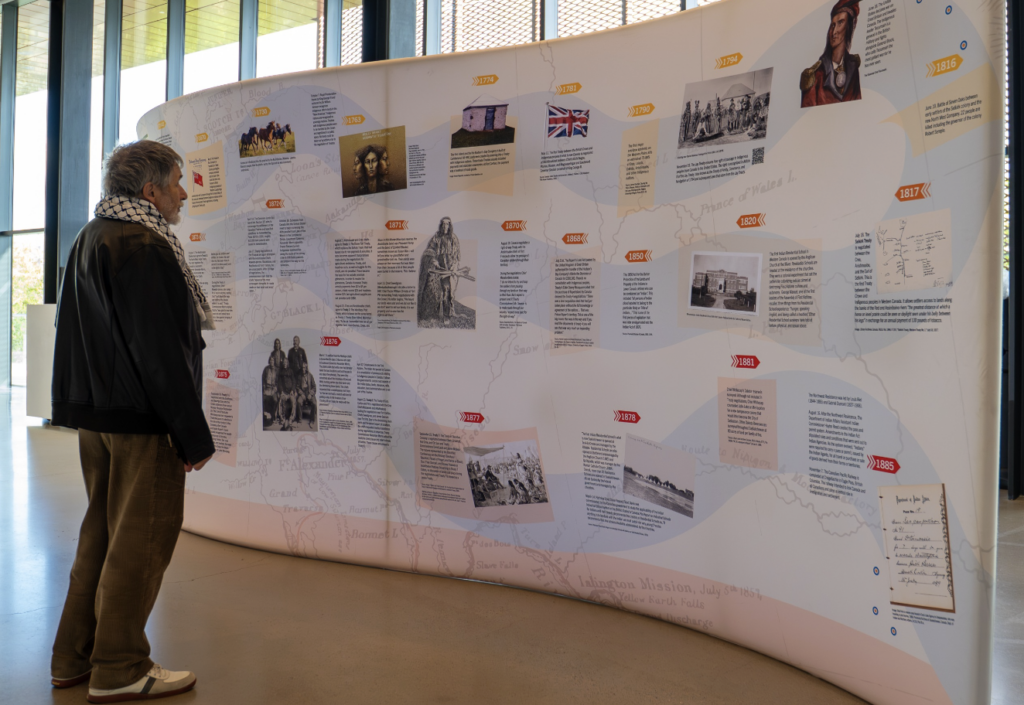
 This year Saskatchewan marked 120 years as a province. The Office of the Treaty Commissioner attended the Sask120 event at the Remai Modern in Saskatoon to help reflect on the story of Treaty governance of these lands.
It’s important to note that the Treaties predate the establishment of the Province of Saskatchewan by three decades and that Treaty boundaries exceed provincial boundaries. Despite the Treaties being foundational constitutional agreements, most people in Saskatchewan don’t know much about Treaties, and that is not by accident.
Teaching Treaties as a foundational pillar of history and governance on this land has not been a fundamental part of the provincial education curriculum. Settlement proceeded without honouring the Treaty relationship, with Treaty nations and citizens often treated as obstacles rather than as partners in forging a peaceful and harmonious way of life for everyone based on sharing the land.
That lack of education has created outstanding issues that First Nations continue to deal with today including the misunderstanding of Treaty rights, the belief that Treaties are outdated, and a lack of awareness that First Nations never surrendered the land.
A big part of the work of the OTC is Treaty education and awareness, a role that is necessary for us all to understand the truth of our shared history: Treaties are the original blueprint for reconciliation and we are all Treaty people.
The Government of Saskatchewan has taken meaningful steps to advance Treaty education over the past 20 years: highway signs mark Treaty boundaries, Treaty education is now mandated in K–12 schools, and the province proclaims Treaties Recognition Week annually.
While important steps, there is still a lot of work to be done. Treaty education needs to be more consistent.
Treaties are not just moral obligations, they are recognized in First Nations core constitutional documents, Canada’s Constitution and internationally in the UN Declaration on the Rights of Indigenous Peoples. Honouring Treaties enables shared success through innovation and ongoing dialogue, nurtures just relationships, and offers a path forward where all people benefit.
Passing of kêhtê-aya Jacob Bill
The Office of the Treaty Commissioner (OTC) mourns the passing of kêhtê-aya Jacob Bill, at age 101. We send condolences to his family, friends, colleagues and the people of Pelican Lake First Nation, Treaty 6.
At his passing, Elder Bill was a member of the OTC’s Treaty kihtehayah Council providing advice on all research conducted by the office and giving guidance to the work of the office as a whole.
He advised the Treaty Table for the OTC in the 1990s and 2000s and contributed to the book Treaty Elders of Saskatchewan: Our Dream Is That We May One Day Be Clearly Recognized as Nations authored by Harold Cardinal and Walter Hildebrandt and based on extensive interviews with Treaty kêhtê-ayak.
Jacob Bill, who was 76 when he was interviewed for the book, was the last surviving voice of the book.
In the book, kêhtê-aya Jacob Bill talks about the Treaties as ‘kihci-asotamatowina’ or as ‘sacred undertakings,’ noting that “When one makes a sacred promise to the Creator … such an undertaking is a grave matter, and it is to be feared in the event of a breach.”
In his final interview with OTC last year, he told interviewer Abel Charles, Grandmother’s Bay, Treaty 6A (1889) simply that “from this Treaty, all life comes from it.”
He will be greatly missed, but his knowledge and teachings on Treaty and the nêhiyawak, which he said means ‘People of the Four Directions’ will live on.
Voices of Treaty 4 available online
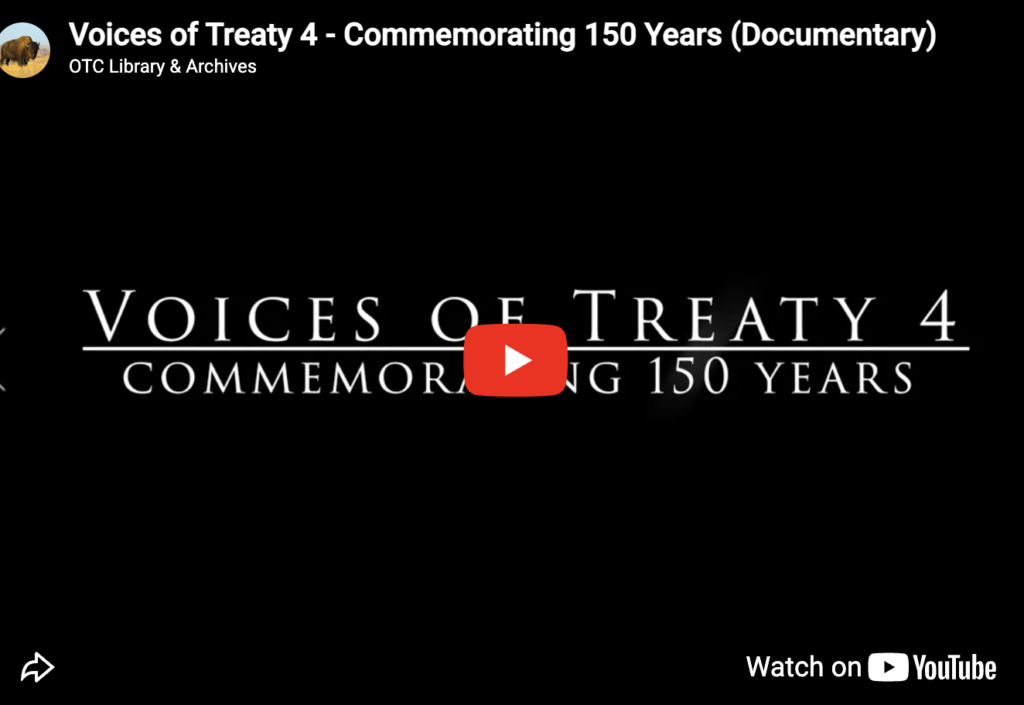
 The Voices of Treaty 4 – Commemorating 150 Years of Treaty documentary by the Office of the Treaty Commissioner is now available free online.
Created as part of the 150-year commemoration of Treaty 4, this film features voices from Zagime Anishinabek, Piapot First Nation, Rolling River First Nation, George Gordon First Nation, Kahkewistahaw First Nation, Kawacatoose First Nation, Okanese First Nation, Cote First Nation, and others.
“Collecting oral history from Elders and knowledge-holders was not a typical interview process. It was based on deep, respectful relationships and local protocols,” said Benji Noon, the film’s director, during the film’s release. “It was truly an honour to speak with all the people in the documentary. I learned so much.”
Voices of Treaty 4 is designed to be a resource not only for Treaty 4 Nations, but for all Treaty people, Saskatchewan residents and Canadians, Indigenous and non-Indigenous.
“Our office is so excited to share this important piece of our Treaty history and are so thankful to the citizens of Treaty 4 for their support and cooperation throughout this project. It would not have been possible without them,” said Dr. Kathy Walker, Treaty Commissioner of Saskatchewan.
“When the project began last year, our goal was to support the preservation of our valuable oral history and narratives, which is a crucial step in our truth and reconciliation journey.”
We invite everyone to watch the film.
Marking Treaty 6 in Stoney Knoll
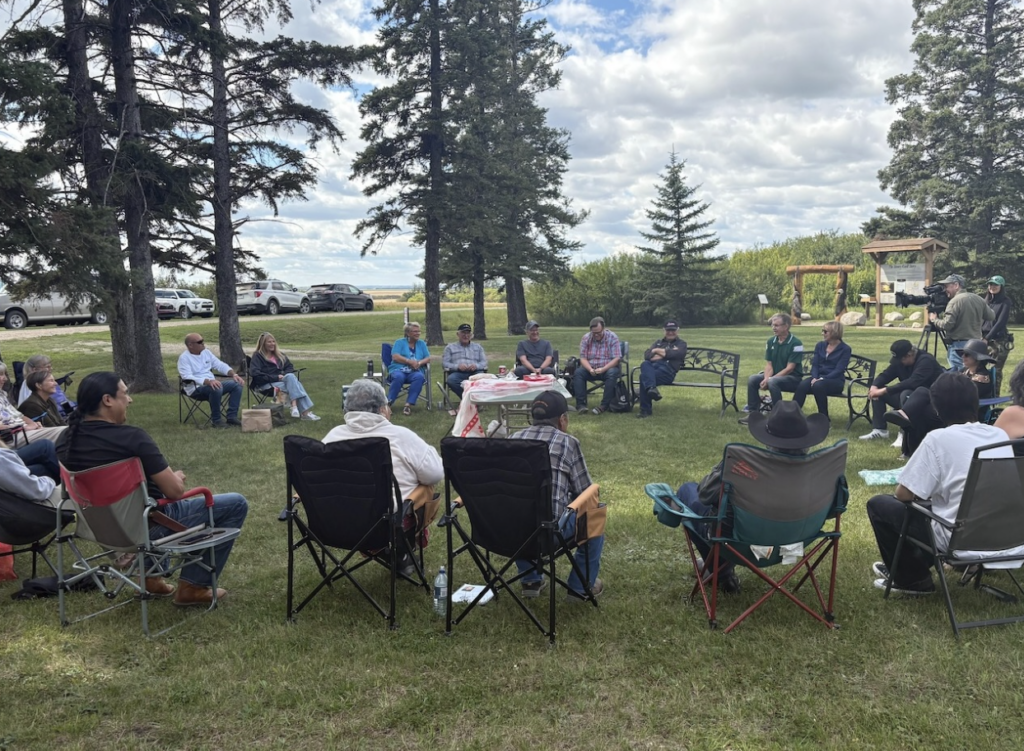
 On Aug. 23, descendants of the Stoney Knoll people came together with descendants of the Mennonite and Lutheran settlers for a gathering at Stoney Knoll to mark the 149th anniversary of the signing of Treaty 6 at Fort Carlton.
The event was held at the Stoney Knoll interpretative site, which acknowledges the Treaty history of the area. The Treaty Commissioner of Saskatchewan, Dr. Kathy Walker, was pleased to be able to attend the event.
In 1876, Chief Chipeewayan and four headmen entered into Treaty and a reserve at Stoney Knoll was surveyed for them, but the descendants of the Stoney Knoll First Nation are still waiting for the land promised under Treaty.
While some progress has been made toward federal recognition and the Stoney Knoll land claim, more work remains. Historically known as the Young Chippewan Band, the community once lived where the town of Laird is now.
The Aug. 23 gathering also marked an MOU signed in 2006 between Stoney Knoll descendants, and local Mennonite and Lutheran residents that committed all signatories to working together peacefully.
Robert Schultz, the last surviving signatory and former chair of St. John’s Lutheran Church, spoke with Treaty Commissioner Walker.
“When we were approached, we just felt we had to open up to everything that was going on,” he said. “I didn’t know what was gonna come out of it.”
The relationship building has become an important part of the MOU, said Walker.
Arrowheads Returned to Beardy’s & Okemasis First Nation
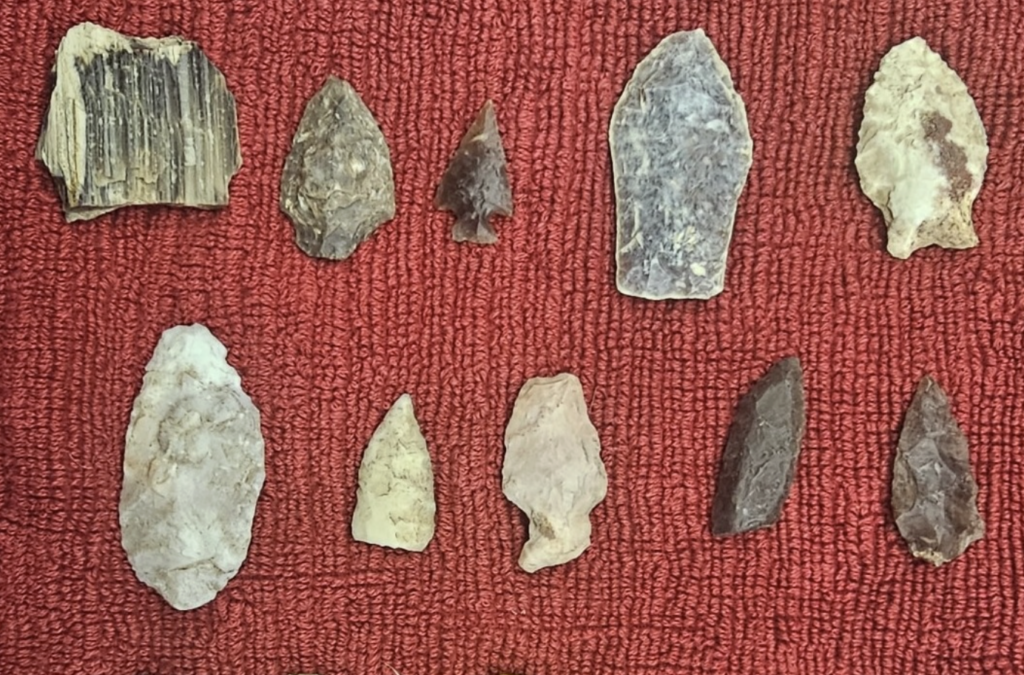
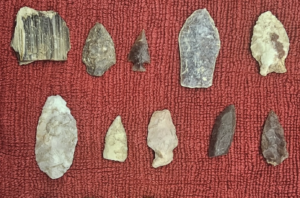 This summer, an act of reconciliation and repatriation took place when Pamela Wintringham returned a collection of arrowheads to Beardy’s & Okemasis First Nation (BOFN). The artifacts, originally found by her grandfather on the family’s farm, were given back to the community that were the original users of the land.
Pamela was inspired to take this step after attending the Office of the Treaty Commissioners’ Treaty Learning Journey in 2024, where she deepened her understanding of the time before Treaty, Treaty making, breaches of Treaty, and reconciliation.
She approached Beardy’s & Okemasis to offer the arrowheads, because she said it felt like the right thing to do.
Chief Edwin Ananas accepted the artifacts on behalf of BOFN and said that they will be preserved and displayed in the Nation’s governance centre.
“I hope that her action moves others to take steps to acknowledge the history of these lands and to honour that history with real action,” said Treaty Commissioner of Saskatchewan, Dr. Kathy Walker.
This shows that individuals have a role to play in the reconciliation journey, and that honouring Treaty relationships begins with respect, understanding, and willingness to act.
International Day of the World’s Indigenous Peoples
The day was chosen to reflect the first meeting of the UN Working Group on Indigenous Populations in 1982.
The Office of the Treaty Commissioner of Saskatchewan appreciates the opportunity to celebrate and reflect on the Treaties signed between First Nations and the Crown as international law.
“kêhtê-ayak have long noted that treaties are international, nation-to-nation agreements,” said Treaty Commissioner Dr. Kathy Walker, “On the 100th commemoration of Treaty 6, leader John Tootoosis said ‘When the Treaty was signed they accepted us as a nation, that is the reason it is a Treaty.’”
The international aspect of Treaty is also reflected in the 1763 Royal Proclamation that recognized Indigenous title and mandated the nation-to-nation process of Treaty-making among First Nations and the British Crown. Many federal government commissioned reports, such as the Royal Commission on Aboriginal Peoples, also have recognized the Treaty relationship as nation-to-nation.
“Treaties are at the heart of our shared future—offering us a blueprint for peace and harmony among nations—to guide how we walk together today.”
International Day of the World’s Indigenous Peoples is a chance to celebrate successes, embrace resilience, and commit to bringing about good relations in the years to come.
OTC celebrates Muskoday First Nation Treaty Day
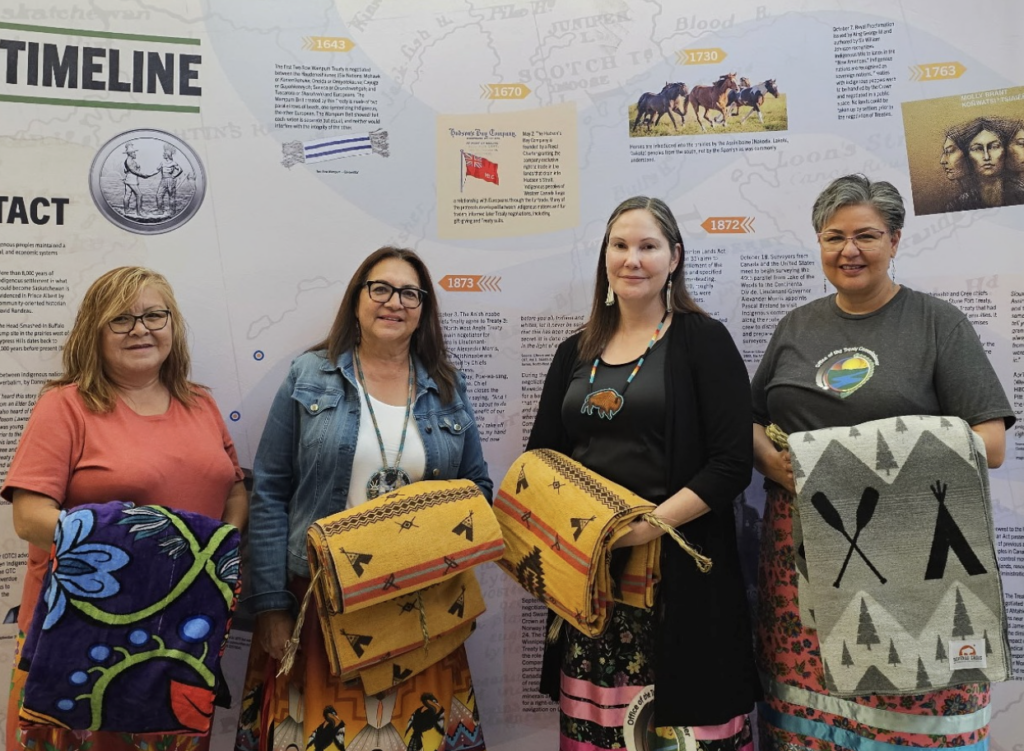
 On Aug. 1, the Treaty Commissioner of Saskatchewan, Dr. Kathy Walker, and members of the OTC team attended Treaty Day on Muskoday First Nation.
Chief Ron Bear and Muskoday First Nation also hosted the Manitoba Treaty Relations Commissioner Loretta Ross and education coordinator Amanda Simard, presenting them with gifts.
“Our office collaborates with the Manitoba Treaty Relations Commission on a number of initiatives because Treaties 1 to 11 are interprovincial,” said Commissioner Walker.
This was Commissioner Ross’ first visit to Saskatchewan to meet with Commissioner Walker, so there was an opportunity to discuss various initiatives, including Treaty education teacher training in Manitoba.
After the Pipe Ceremony, and speeches, there was a feast led by Elder George Saddleback.
OTC at the Treaty 10 Gathering
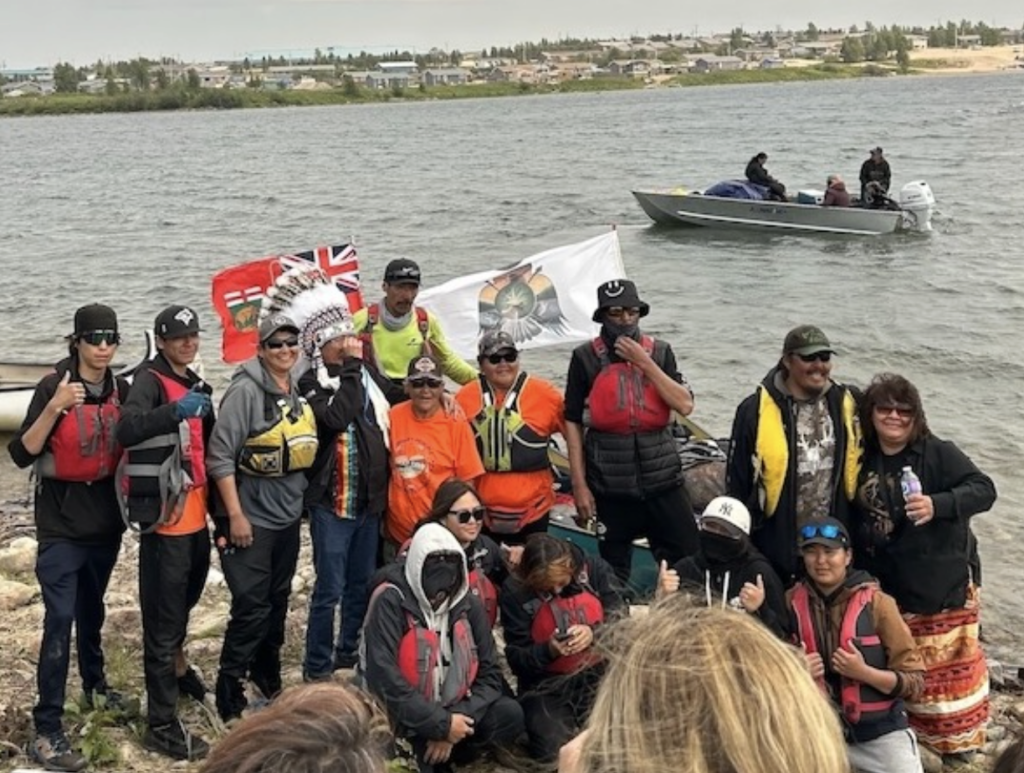
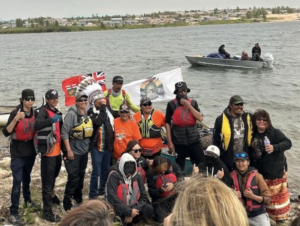 Treaty Commissioner of Saskatchewan, Dr. Kathy Walker, was pleased to attend the Treaty 10 Gathering this July held at Hatchet Lake.
“The gathering provides a way for nations to come together on an annual basis to renew the terms of Treaty 10,” said Walker. “The event brings together kêhtêyak, leaders, citizens and young people to breathe life into the Treaties with our words and actions, and thereby strengthen the Treaty relationship.”
The event started in a good way with a prayer by an esteemed Dene Elder and Dene and nêhiyawak drumming. Elders and knowledge-keepers shared their knowledge of Treaty history, provided cultural demonstrations, such as hide tanning, and spoke of the remarkable strength and resilience of the generations who walked before us. A major highlight was the arrival of youth paddlers who arrived in canoes at the site, following a traditional waterway route of Treaty 10 Nations. Hatchet lake Denesuline nation citizen Rosalie Tsannie also received well-deserved, special recognition for her lifelong leadership.
Treaty 10 includes First Nations in the northern part of Manitoba, northeastern Saskatchewan, and a small part of east central Alberta. The Treaty was first agreed to on Aug. 28 1906 at Ile a la Crosse; Sept. 19, 1906 at Canoe Lake; and on August 19, 1907 at Lac la Hache at Lac du Brochet on the north end of Reindeer Lake.
With regard to the making of Treaty 10, Denesuline Elder Louie Benoanie from Hatchet Lake stated in the 1990s:
“The people loved their land, they wanted to keep their land, they wanted to live on their land. The runway, the water, the fish, the water-fowl, everything—we don’t want to be bothered [in] exercising our traditional way of life. If you can guarantee us that he will make the treaty as what the people want and that’s what I understand of the treaties. The way I look at it, the way I understand it today.”
When First Nations signed on to Treaty 10, protecting their way of life and securing livelihoods for the community were emphasized. At the time Indigenous people were experiencing falling fur prices, scarcity of game, and miners encroaching on their communities.
Work still continues today to ensure the full implementation of the Spirit and Intent of Treaty 10 and all the numbered Treaties.
150 Years of Treaty 5
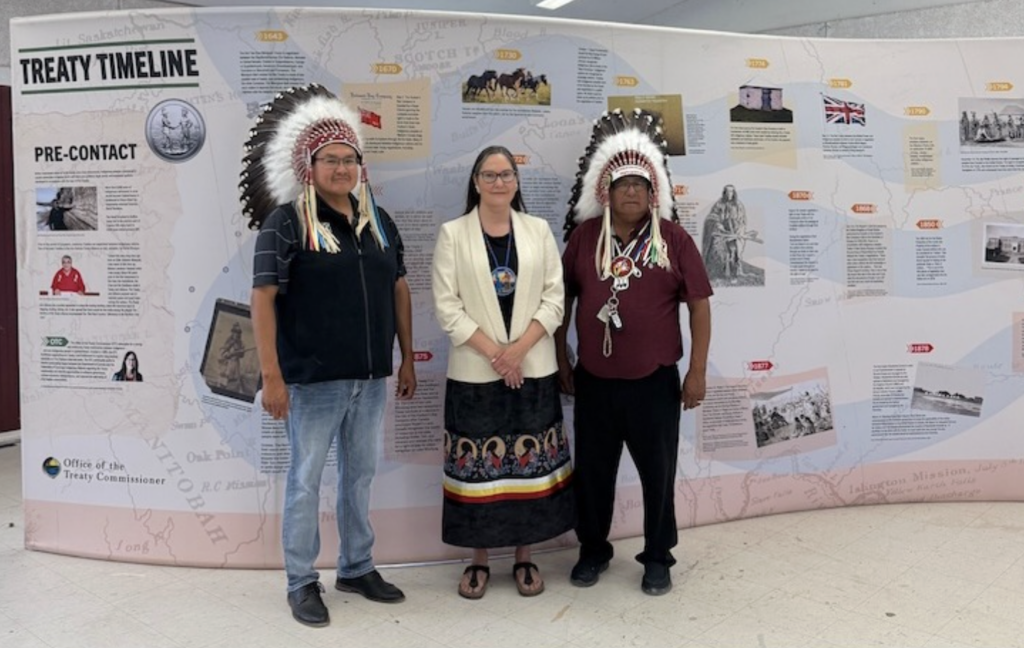
 The Office of the Treaty Commissioner was pleased to travel to Red Earth Nehiyawak Nation or Mihkoskiwakak Nehiyawak with the Treaty Timeline to commemorate 150 years of Treaty 5.
Treaty Commissioner of Saskatchewan Dr. Kathy Walker met with Chief Zachary Whitecap and Vice Chief Fabian Head for their Treaty Days.
Alongside the Mihkoskiwakak Nehiyawak, Cumberland House Cree Nation and Shoal Lake Cree Nation are commemorating 150 years of Treaty 5 with the Oji-cree, Ojibway (Anishinabek), Cree, and Denesuline nations that belong to Treaty 5, which encompasses over 1 million acres.
Treaty 5, also known as the Winnipeg Treaty, was agreed to on Sept. 20, 1875 (Berens River) and Sept. 24, 1875 (Norway House) with adhesions in the following years. It includes communities in central and northern Manitoba as well as small areas of Saskatchewan and Ontario.
To commemorate 150 years of Treaty 5, Elders, leadership and citizens from many nations, language groups, and areas will gather at Berens River First Nation to renew the Spirit and Intent of Treaty, their relationship to the land, and their right to earn a living from the land.
A Summit of Treaty 5 Sovereign Nations hosted by Berens River First Nation will take place on September 18th, 19th, & 20th, 2025. You can find more information here