
Posts by Angela Hill
OTC celebrates the graduates of 2026
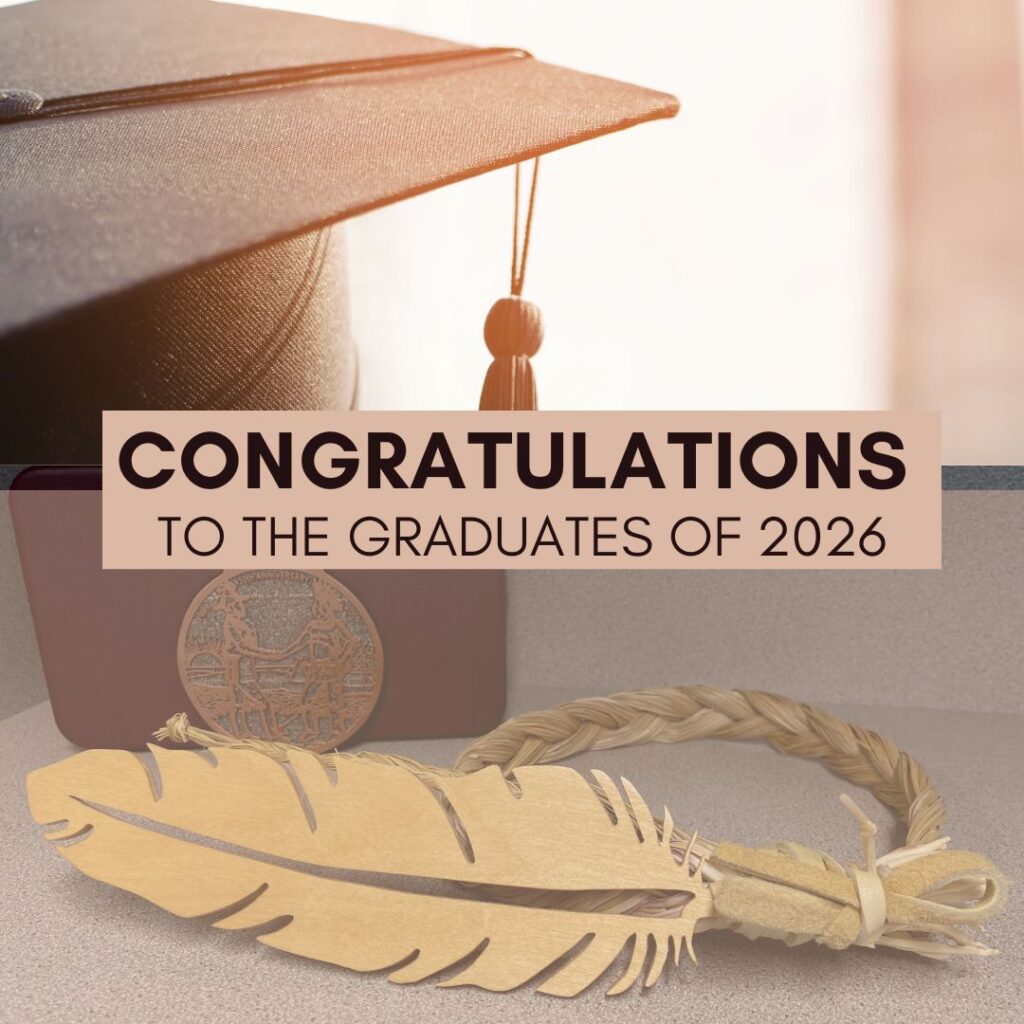
 The Office of the Treaty Commissioner congratulates all graduates on completing an important life milestone. Your perseverance in completing your education reflects resilience and determination.
As you move forward, you carry the Treaty Right to Education as intended, along with the knowledge and experiences you’ve gained along the way. Your education is a foundation for future opportunities.
Take pride in how far you’ve come, and step forward with confidence into what comes next. We are proud of your achievement and look forward to your future contributions.
In particular we’re celebrating two graduates from our team this year, Eli from Kawacatoose First Nation and Mistawasis nehiyawak, and Maria from Peter Chapman Band and Wahpeton Dakota Nation.
National Indigenous Peoples Day
National Indigenous Peoples Day is June 21.
Across Treaty territories, the day is an opportunity to celebrate Indigenous cultures, languages, and knowledge systems that continue to not only survive, but thrive on the land. Language remains central to the relationship between Indigenous communities and the earth. Language carries stories and teachings that connect people to place.
“It’s a time to celebrate vibrant Indigenous cultures and contributions, but also a reminder of our shared responsibility to honour the Treaties. Treaties are not just about history; they are living documents, a blueprint for living together and reconciliation,” said Dr. Kathy Walker, Treaty Commissioner of Saskatchewan.
June 21, is also the summer solstice, the longest day of the year and referred to as the Indigenous New Year, said Dr. Walker.
“It marks a season of renewal and is celebrated through ceremony, connection, and honouring.”
The Office of the Treaty Commissioner invites everyone to use the day celebrate Indigenous languages, cultures, and communities.
Commemorating National Indigenous Peoples Day and the 150th Anniversary of Treaty 6 at Fort Battleford
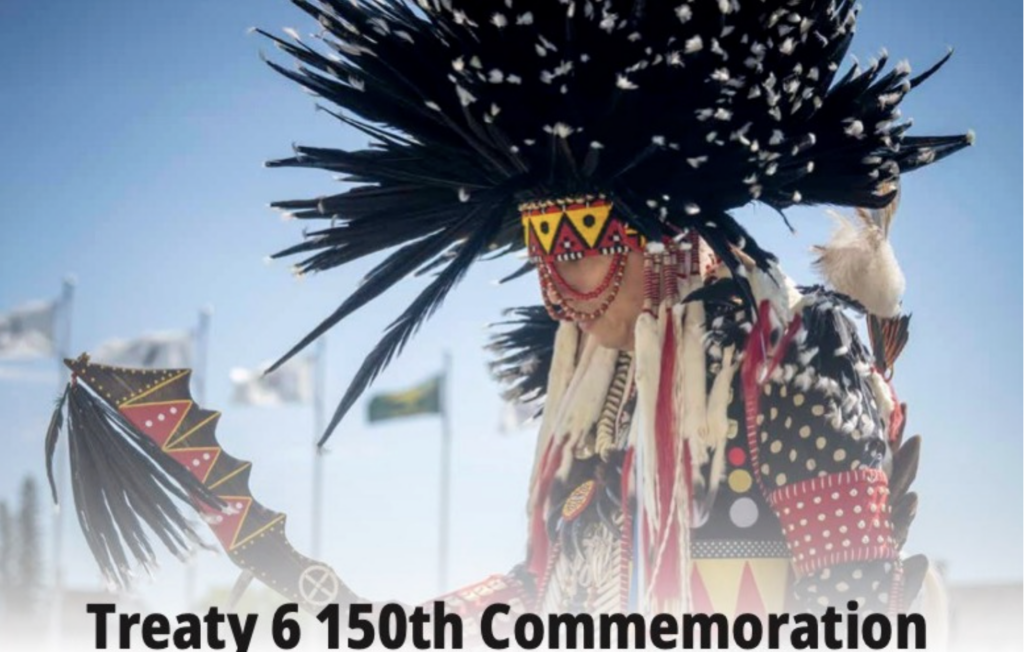
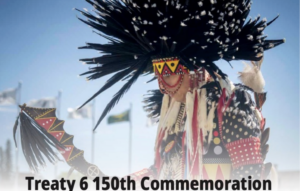
The event brought together Treaty 6 leadership, community members, Elders, Knowledge Keepers, performers, and vendors for a day of learning and reflection on the last 150 years of Treaty governance. The lieutenant governors of both Saskatchewan and Alberta were also in attendance, which is an acknowledgment of their roles in upholding Treaty as the Crown’s highest representatives in Canada.
Treaty 6 was first agreed to on August 23, 1876 with Chief Mosquito being the only nation to agree to Treaty 6 at the Fort Battleford site, which occurred in 1878. A total of 54 First Nations agreed to Treaty 6 across the lands known as Alberta and Saskatchewan. The Treaty has had profound impacts on many of the Indigenous Peoples who interacted with the Fort and whose histories are connected to the region.
“Treaty 6 is more than a historical agreement, it is a living document. As we commemorate the 150th anniversary of the signing of Treaty 6, we have an opportunity to reflect on the undertakings agreed to by our ancestors and the responsibilities we share today. Living the Treaties means using these agreements to guide reconciliation and to build for future generations to come,” said Dr. Kathy Walker, Treaty Commissioner of Saskatchewan.
Activities began with a Pipe Ceremony, Flag raising, and a grand entry and opening ceremony led by Treaty 6 First Nations leadership and included cultural performances, storytelling, children’s activities, and an outdoor market.
As part of the commemoration, participants had the opportunity to learn more about the history and ongoing significance of Treaty.
National Indigenous History Month
 June is National Indigenous History Month in Canada, a time to recognize and celebrate the rich histories, diverse cultures, languages, and contributions of First Nations, Inuit, and Métis Peoples.
Designated by the House of Commons in 2009, National Indigenous History month creates space to honour the stories, achievements, and resilience of Indigenous Peoples. It is also a time to deepen our understanding of the Treaty relationship and the shared responsibilities that continue to shape our communities and our future.
Throughout history, Indigenous leaders have worked tirelessly to protect their Peoples, cultures, and ways of life while advocating for justice, respect, and self-determination. One such leader was Chief Mistahi Maskwa (Big Bear), whose commitment to his people and thoughtful approach to Treaty negotiations reflected a deep concern for future generations. His efforts remind us of the importance of understanding Indigenous perspectives and the historical context of Treaty relationships in Canada. **Read more at the end.
“Treaties are not simply historical documents—they are living agreements that continue to guide our relationships today. National Indigenous History Month invites us to learn from the past, honour the spirit and intent of the Treaties, and strengthen our shared commitment to respect, responsibility, and reconciliation,” said Dr. Kathy Walker, Treaty Commissioner of Saskatchewan.
The Office of the Treaty Commissioner encourages people to use National Indigenous History month to start (or continue) their reconciliation journey by furthering their knowledge.
National Indigenous History Month In Canada https://www.rcaanc-cirnac.gc.ca/eng/1621447127773/1621447157184
OTC Recommends https://otc.ca/pages/recommended_by_the_otc.html
ConnectR https://www.beaconnectr.org/
2024 National Indigenous History Month: A thematic Learning Series https://www.halifaxpubliclibraries.ca/blogs/post/national-indigenous-history-month-2024-a-thematic-learning-series/
**According to Dr. Blair Stonechild, professor emeritus at First Nations University of Canada:
Around 1825 Big Bear, the son of a Saulteaux (Anishinaabe) Chief, was born in the area of Jackfish Lake. As a boy, Big Bear learned the traditional skills of hunting buffalo and other wild game. Big Bear’s early life was marked by some difficult times. In the hard winter of 1833, his people suffered near-starvation because the buffalo were difficult to find. Then in 183, a dreaded smallpox epidemic spread into Canada from the American territories and wiped out two-thirds of some tribes such as the Blackfeet and Assiniboines. Big Bear, thenonly 12 years old, survived but was left with disfiguring marks on his face.
As a young man, Big Bear was noted for his serious-mindedness, intelligence, and his ability to laugh at himself. He also took visions seriously. In an early vision quest he went into isolation to fast and pray. In the vision, a bear spirit, most powerful of animals, offered to be his protector. He prepared war medicine according to directions in the vision. Stories of his courage and feats of war became commonplace around the campfires.
Big Bear arrived late at the Treaty negotiations in 1876. When Chiefs such as Sweetgrass were out hunting, messengers were sent to bring them in. However, no messenger was sent for Big Bear or Little Pine, Chiefs known to be difficult to deal with. This was a common tactic of government to get only those Chiefs whom they knew to be sympathetic to the Treaty to dominate the meetings. Unfortunately, the assembled Indians, known to favor the Treaty, signed it the day before Big Bear arrived. Big Bear had been consulting other Plains Bands who were out hunting so he could carry their wishes to the meeting. He voiced his objections:
I find it difficult to express myself because some of the bands are not represented. I have come off to speak for the different bands that are out on the plains. It is no small matter we were to consult about. I expected the Chiefs here would have waited until I arrived. The different bands that are out on the plains told me that I should speak in their stead, the Stony Indians as well. The people who have not come, stand as a barrier before what I would have had to say: my mode of living is hard.
Interpreters frequently made mistakes during the translation. Cree is a difficult language to understand, especially in its abstract usage. In this case, their usual interpreter, Peter Erasmus, had left and Reverend McKay, a poorer interpreter, was used. He had been having trouble and became confused. He mistook “lead by the neck” for “hang by the neck”.
What Big Bear really meant was that he did not want to lose his freedom, as an animal with a rope around its neck, but the misinterpretation stuck. Big Bear already had a reputation as a stubborn man, and now whites were also thinking he had something evil in him, or was of criminal bent. This would return to haunt Big Bear for many years, as officials used it to dismiss him as an evil, cowardly Indian. After that, the opportunity for real discussion was lost, both Big Bear and Morris deciding to leave further discussion for another year. Before Morris left, Big Bear again attempted to clarify his intentions:
I am glad to meet you, I am alone; but if I had known the time. I would have been here with all my people. I am not an undutiful child, I do not throw back your hand; but as my people are not here, I do not sign. I will tell them what I have heard, and next year I will come.
Big Bear had been aware of the revison in 1875 of Treaties One and Two signed in1871. It would therefore be possible, he reasoned, to get revisions to Treaty Six. By holding out from signing, he hoped he would be able to obtain better terms. In 1877 the Commissioner did not return but instead sent a clerk who was empowered only to pay annuities and take adhesions. He had no power to negotiate different terms of Treaty.
Big Bear decided he would wait a total of four years and see what would happen before deciding whether he would sign the Treaty. He returned to see Commissioner Laird and announced that he would seek no further meetings unless the government asked him to do so. In the meantime, he told Laird, he would “watch to see whether the Government would faithfully carry out its promises to the lndians.”
Finally Big Bear, thinking of the needs of his Band, approached Police Commissioner Irvine in a last attempt to get better Treaty terms. Over several days, in sessions sometimes extending well into the night, Big Bear pointed out the shortcomings of the Treaty and his apprehensions about signing it, but it was of no use. Finally on December 8, 1882, after giving a four-hour speech, Big Bear realized that further attempts would be fruitless and signed his mark on an adhesion to Treaty Six.
Recognizing our shared Treaty history and relationship
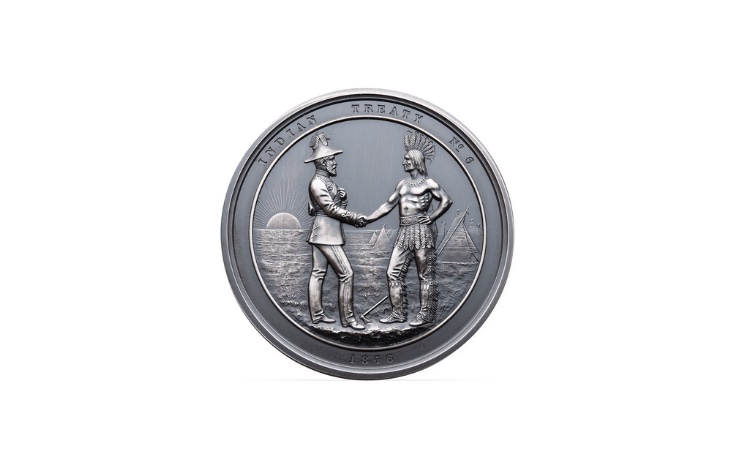
The Treaty medals exchanged as part of gift-giving during Treaty negotiations symbolize this enduring commitment of working together.
On the medals, two figures shake hands amidst the sun, grass and rivers in the background, thus agreeing to a relationship of peace, friendship and respect for as long as the sun shines, the grass grows and the rivers flow. As added emphasis, the figure of a hatchet is buried beneath their feet.
Across Treaty territories 1 to 5, this Treaty relationship has endured for more than 150 years; and this year, we commemorate 150 years of Treaty 6—which extends across Saskatchewan and far into the territories where Albertans now make their homes.
These medals are an enduring symbol that We are All Treaty People. This shared history helped shape the constitutional development of Canada and the creation of provinces across the Prairies.
In Saskatchewan, a groundswell of citizens and leaders have walked alongside one another to recognize our shared Treaty history and to build from it for our shared future.
Here are some highlights of the results of working together:
- In 1992, First Nations and other levels of government in Saskatchewan became the first to sign a Treaty Land Entitlement Agreement and Framework
- Since 1989, First Nations in Saskatchewan have been leaders in urban reserve creation and wealth generation—emerging to contribute billions annually to local, provincial and federal economies
- In 2008, Saskatchewan became the first province to mandate teaching Treaty in classrooms from Kindergarten to Grade 12
- In 2024-2025, the Saskatchewan Indian Gaming Authority contributed $36.5 million (25 per cent of $146 million in total net income) to the provincial government from First Nations owned and operated casinos
- Since 2015, grassroots people in Saskatchewan have formed Reconciliation Circles and later the Treaty Land Sharing Network to help build awareness and further action on Treaty implementation
- In 2025, the Saskatchewan Urban Municipalities Association signed an MOU with the Office of the Treaty Commissioner, committing to working together on Treaty education and implementation
- In 2025-2026, several locally-owned, Saskatchewan businesses stepped up to sponsor the Treaty 6 150th Commemoration demonstrating commitment to respectful partnerships
We Are All Treaty People
In 1982, when Canada repatriated its Constitution, it recognized and affirmed existing Aboriginal and Treaty rights under Section 35, and is thereby bound by the honour of the Crown to uphold these rights. Canadian provinces hold limited authority and jurisdiction through the Canadian federation.
The Constitution includes the Royal Proclamation of 1763. It sets out the Crown’s understanding of the processes required for its governments to enter onto First Nation lands. First Nations governments negotiate in accordance with their longstanding traditions of Treaty-making, and the Crown negotiates for Canada in accordance with its own customs and laws.
All of Saskatchewan is Treaty territory, not just reserve lands. The numbered Treaties were intended to protect First Nations ways of life for future generations and to mitigate the impacts of settlement on lands and livelihoods. All those who live in shared Treaty territories are intended to benefit from Treaties. We are all Treaty People. Even though the Crown has a long history of passing policy that has not honoured First Nations understandings of Treaty, First Nations have maintained their Treaty obligations and continue to share the lands in peace and harmony with their Treaty partners.
Proposed changes to the Constitution Act that threaten the integrity of the numbered Treaties are not merely provincial issues; they are Treaty issues. The potential separation of any province affects all those who hold rights under Treaties 1 to 11 as the Treaties are an interrelated bundle.
In keeping with our mandate, which includes public education on Treaty, the OTC expresses concern about rhetoric that seeks to undermine or diminish the constitutional protection afforded to Aboriginal and Treaty rights under First Nations law and the Canadian Constitution. The OTC believes that language portraying these rights as illegitimate or incompatible with democracy can contribute to misunderstanding, polarization, and discrimination against First Nations. While public debate about constitutional issues is protected in a democratic society, Canadian law also recognizes limits where expression crosses into the willful promotion of hatred against identifiable groups.
In addition, rhetoric that frames Aboriginal and Treaty rights as anti-democratic has broad consequences for all of Canada. Treaties are a foundational pillar of Canadian democracy, contributing to the legitimacy of Canada’s claims to sovereignty in much of the West. The courts have interpreted the purpose of s.35 as reconciling Indigenous peoples’ inherent sovereignty with Crown assertions. The federal government recognizes First Nations self-government as part of s.35 in its 1995 Inherent Rights Policy. Efforts to dismiss or minimize s.35 threaten the self-determination of First Nations across Canada.
Aboriginal and Treaty rights are also protected under Section 25 of the Canadian Charter of Rights and Freedoms, which requires the rights and freedoms guaranteed to all citizens under the Charter to be interpreted in ways that do not threaten Aboriginal and Treaty rights.
To deny, disparage or diminish Treaty rights undermines the truth that we are all Treaty people.
Treaty Recognition Week: Upholding Treaty
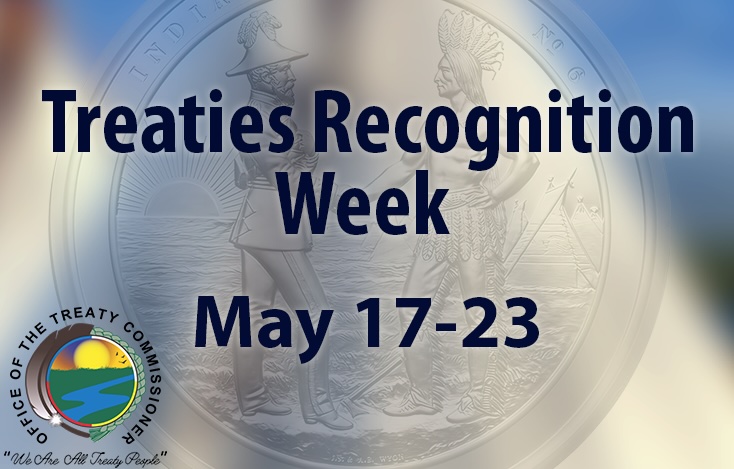
 The numbered Treaties are not only historical, but are a living relationship that guides how we live together today as Treaty People.
“Treaty starts with having all our children understand that they belong and are loved and that their cultures and traditions and languages matter and are valued,” said Dr. Kathy Walker, Treaty Commissioner of Saskatchewan
“Upholding Treaty really is about realizing the vision that the Treaty partners had when they came together, which was really to learn about how we could live together in true relationship with one another, understanding that we are interrelated.”
The opening of a Birthing and Traditional Parenting Centre in Sturgeon Lake First Nation is one key example of what it means to uphold Treaty. Supporting children, families, language, culture, and traditional knowledge reflects the values Treaties were built on.
In his book Who We Are: Four Questions for a Life and a Nation, Murray Sinclair reflects on four important questions:
Who am I?
Why am I here?
Where do I come from?
Where am I going?
As Treaty People, we are meant to think about these questions together. Treaty reminds us that our lives are interconnected and that we share responsibility for one another.
May 17-23, 2026 is Treaty Recognition Week in Saskatchewan. One thing every Treaty person can do is learn the history of Treaties and recognize the contributions of First Nations ways of knowing and being. Upholding Treaty begins with respect and relationship building now and for the generations to come.
Office of the Treaty Commissioner and Regina Public Schools sign MOU on Treaty Education
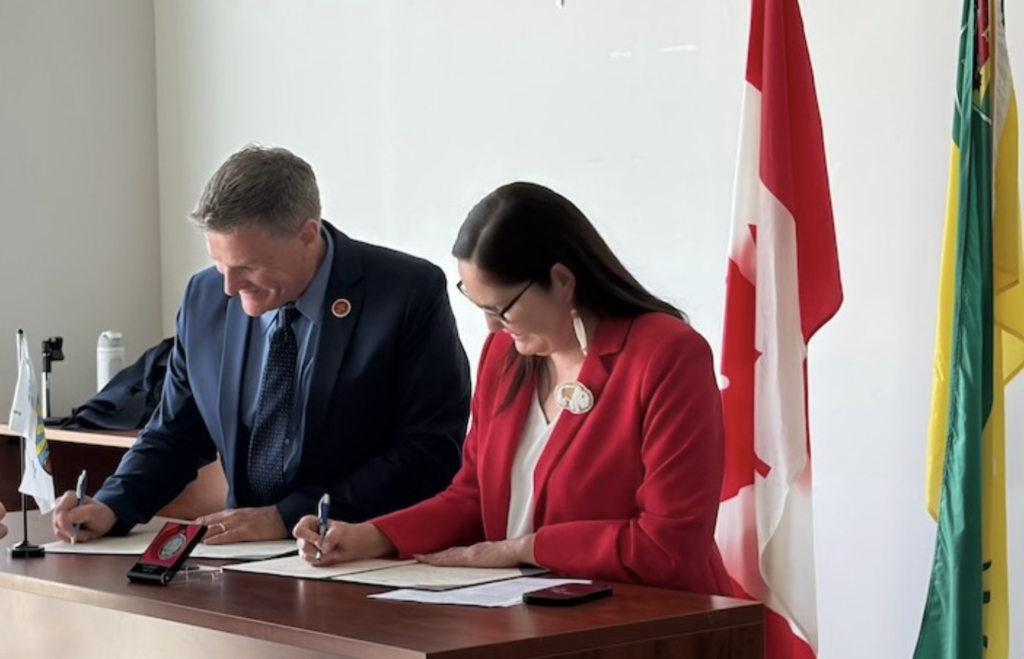
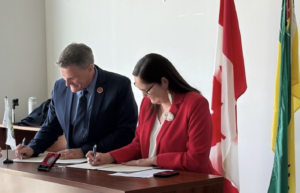
The Office of the Treaty Commissioner (OTC) and the Regina Public School Division (RPSD) signed a Memorandum of Understanding this morning at the mâmawêyatitân centre, located at Scott Collegiate.
The MOU is aimed at enhancing collaboration and support between RPSD and the OTC that will promote Treaty education and Treaty Rights and Responsibilities through the implementation of the Treaty Outcomes of the Saskatchewan Ministry of Education. It also enables ongoing collaboration to help guide RPSD’s strategic plan as it pertains to the inclusion of Indigenous concepts, history, culture, community and inclusion of Indigenous narratives and perspectives.
“Regina Public Schools is committed to recognizing and honouring the Indigenous Peoples of Saskatchewan’s Treaty Nations, and a critical part of this is in the classroom,” said Mark Haarmann, Director of Education and CEO at Regina Public School Division. “We are grateful for our time engaging with the Office of the Treaty Commissioner and look forward to deeper collaboration on enhancing Indigenous and Treaty education in our schools. We are all Treaty people.”
Good for five years, the MOU will enable the creation of shared education projects that promote understanding on Treaties as well as the United Nations Declaration on the Rights of Indigenous Peoples, Canada’s Truth and Reconciliation Commission Calls to Action, and the Missing and Murdered Indigenous Women and Girls Calls to Justice. Part of these projects include exhibits at RPSD museum locations, special off-site exhibits, and traveling exhibits, whenever feasible.
“The concrete actions being taken to implement Treaty education are for our children and future generations—so they may understand the truth of our shared history,” said Dr. Kathy Walker, Treaty Commissioner of Saskatchewan. “By creating a partnership with Regina Public Schools, we are strengthening opportunities for students, educators, and communities to learn what it means to live the Treaties. By understanding our shared history and what it means to be a Treaty person, we can create a stronger future for everyone.”
Both parties will meet annually to review progress made, discuss opportunities for improvement, and ways to deepen education around Treaty Rights and Indigenous culture, history, and more.
Star Blanket Buffalo Return
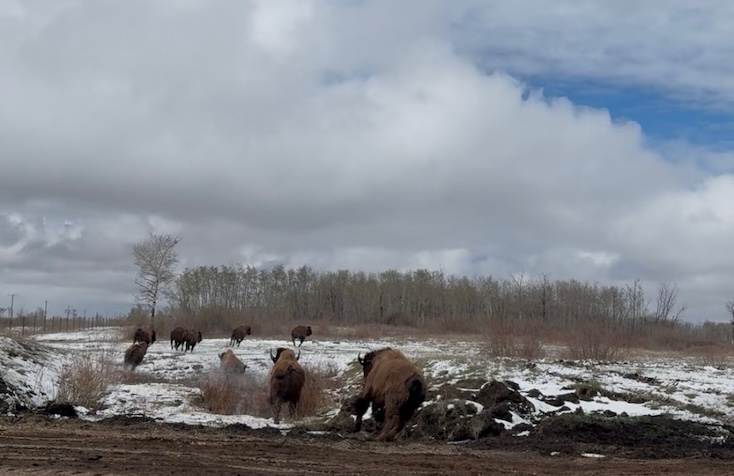
The Treaty Commissioner of Saskatchewan, Dr. Kathy Walker was honoured to be invited to witness the historic return of buffalo to Star Blanket Cree Nation. The event marked a time of reconnection and cultural renewal.
Fifteen buffalo total 13 — 13 females and 2 males — made their journey home from Carstairs to Star Blanket Cree Nation, where community members gathered to celebrate their return to the land.
“The return of the buffalo is a powerful reminder of the deep connection between First Nations and the land. The returning of the buffalo is a celebration of resilience and perseverance,” said Treaty Commissioner Walker.
Star Blanket Cree nation is a signatory to the Buffalo Treaty, which has been signed by more than 40 First Nations. The purpose of the Buffalo Treaty is to restore the buffalo to their homelands and to renew the cultural, spiritual, and ecological relationships between First Nations and the buffalo.
Following the arrival of the buffalo, families, Elders, leaders, and guests came together at White Calf Gym for speeches, visiting, and supper to honour the significance of the historic day.
Treaty Recognition Week 2026
The Office of the Treaty Commissioner is pleased to help fulfil the call to action by our future generations to have the third week in May proclaimed Treaties Recognition Week.
A Grade 5 Class at Ecole Lumsden Elementary and their teacher, Justin Freitag, introduced the Treaties Recognition Week initiative in 2023 after being inspired by a Treaty 4 flag-raising in Lumsden.
For the third year, the Government of Saskatchewan is proclaiming May 17–23 as Treaties Recognition Week in Saskatchewan calling on all citizens to recognize Treaty.
This annual event recognizes the Treaty relationship and the Office of the Treaty Commissioner invites people across Saskatchewan to better understand our shared history.
“Treaties Recognition Week is an opportunity for all of us to learn, reflect, and strengthen our common understanding of Treaty. Together, we can honour the Spirit and Intent of Treaty,” said Dr. Kathy Walker, Treaty Commissioner of Saskatchewan.
Treaties are agreements made to ensure peaceful relations and the continued livelihood of both First Nations and non-First Nations peoples. Understanding this shared history helps us recognize the commitments made by all and the responsibilities we carry forward. Learning about Treaty nurtures mutual respect, strengthens relationships, and supports reconciliation efforts across the Treaty territories.
Whether you are Indigenous or non-Indigenous, if you live in Saskatchewan, you are a Treaty person. Treaties are not just historical documents—they are living agreements that shape our shared present and future.
The Office of the Treaty Commissioner offers resources to guide you through the Treaty timeline: Before Treaty, At Treaty, After Treaty, and Today. Explore these materials to deepen your understanding and join communities across Saskatchewan in recognizing the importance of Treaty.
Before Treaty
We have resources for students in:
Primary Grades
Virtual Tipi building
The word Indigenous — explained l CBC Kids News grades k-4
Middle Grades
Grandfather Teachings – Video Series
Secondary Grades
7 Sacred Teaching; eagle feather & tobacco protocol
and the General Public
Indigenous Worldviews vs Western Worldviews
At Treaty
We have resources for students in:
Primary Grades
Alex Shares His Wampum Belt
We Are All Treaty People
Middle Grades
Treaty Relationships – A Reading
Secondary Grades
The OTC Treaty Video – A Solemn Undertaking
and the General Public
Treaties with Indigenous Peoples in Canada, Explained
After Treaty
We have resources for students in:
Primary Grades
Phyllis’s Orange Shirt
Middle Grades
My Suitcase by Nii Sookayasas
Stolen Words by Melanie Florence
Secondary Grades
Indian Act video
Phyllis Webstad – On Orange Shirt Day
and the General Public
Murray Sinclair’s response to “Why don’t people just get over it?”
And Today
We have resources for students in:
Primary Grades
The UNDRIP explained – Animated
Middle Grades
What is Reconciliation?
Secondary Grades
Our Rights: Indigenous Youth on the United Nations Declaration on the Rights of Indigenous Peoples
and the General Public
Truth and Reconciliation Commission’s calls to action, six years later
How UNDRIP Changes Canada’s Relationship with Indigenous Peoples